

In today’s world, remote work isn’t just a trend — it’s a necessity.
Companies of all sizes are looking for reliable ways to give employees secure access to desktops and applications from anywhere. This is exactly where VDI (Virtual Desktop Infrastructure) comes in.
If you’ve heard the term but never really understood what VDI means or how it works, this guide will walk you through everything in simple language.
What Exactly Is VDI?
VDI stands for Virtual Desktop Infrastructure, a technology that hosts desktop environments on a centralized server instead of on individual PCs.
Instead of each employee having a fully installed Windows desktop on their device, the desktop lives in the data center or cloud — and users access it remotely.
Think of it as:
“Your Windows desktop, running in the cloud, accessible from any device.”
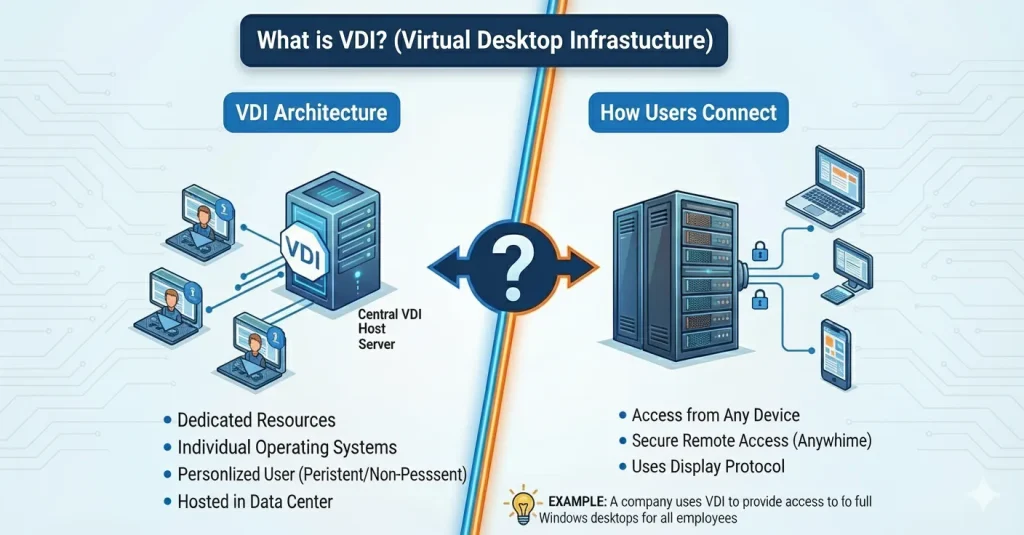
How Does VDI Work?
A VDI setup has three main components:
1. Central Server (Host Machine)
This is where multiple virtual desktops are created and managed.
2. Hypervisor
Software such as VMware ESXi or Microsoft Hyper-V that creates and runs virtual machines.
3. Connection Broker
A system that connects users to the right virtual desktop when they log in.
The user opens a client (or even a web browser), enters their credentials, and instantly gets their desktop — no matter where they are.
Why Do Businesses Use VDI?
● Strong Security
Data never leaves the data center. If a laptop is stolen, no data is compromised.
● Cost Efficiency
Older or weaker devices can still run a VDI session smoothly.
● Remote Work Flexibility
Employees access the same desktop from home, office, tablet, or even a phone.
● Easier IT Management
Updates are installed once on the master image and applied to all desktops.
Types of Virtual Desktop Infrastructure
Not all VDI is the same. The two main types are:
1. Persistent VDI
The user gets the same desktop every time — like a personal computer.
2. Non-persistent Virtual Desktop Infrastructure
Each session resets after logout. Great for call centers or shared-use environments.
Is VDI Right for Your Business?
If your organization values security, remote access, centralized management, and long-term cost savings, Virtual Desktop Infrastructure may be one of the best investments you can make.
Whether you’re a growing business or a large enterprise, VDI provides a reliable and scalable foundation for modern work.